
Introduction
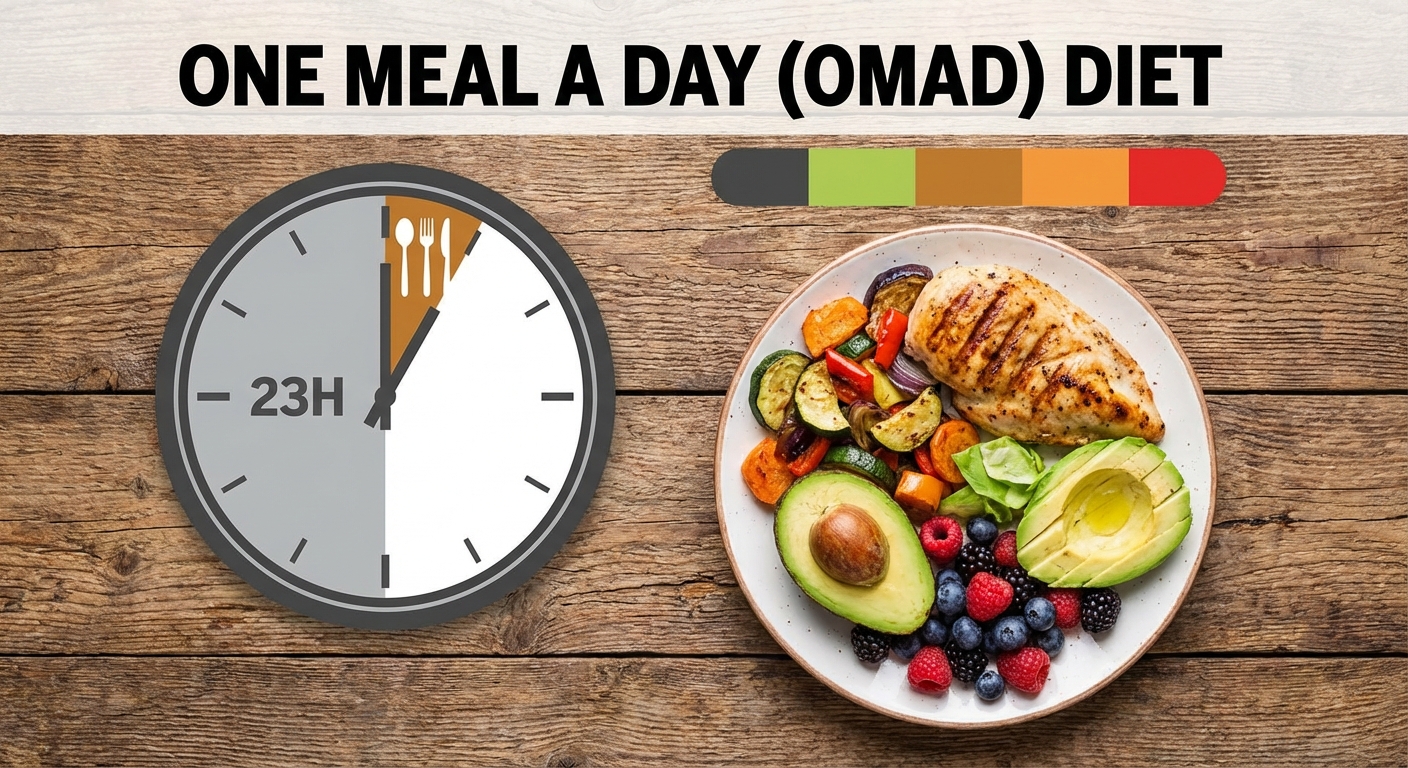
OMAD, One Meal A Day, is an extreme form of fasting. Unlike classic intermittent fasting with eating windows, OMAD allows only one meal per day. As a permanent dietary form, this is not sensible. As a temporary tool, however, it can be surprisingly effective in certain life phases.
The value of OMAD lies not in health promises, but in handling willpower under stress.
OMAD addresses a real evening problem
Many people do not fail at breakfast or lunch, but in the evening. Calorie balance is controlled during the day; in the evening it collapses. Willpower is depleted, decisions become worse, impulse control drops.
A crucial finding:
For some people, it barely matters how they eat during the day. Hunger comes reliably in the evening.
When this is the case, classic calorie distribution becomes a daily battle against yourself. OMAD reverses this game.
OMAD is not a nutrition plan, but a willpower bypass
Willpower behaves like an exhaustible muscle. It is depleted over the course of the day. This is precisely why diets often fail in the evening.
OMAD eliminates this decision phase completely. There is no calorie calculation throughout the day, no weighing, no internal negotiating. Eating is clearly time-limited. Everything before is not renunciation, but postponement.
In this way, OMAD functionally resembles a morning routine. It is not a miracle, but a structure that replaces decisions.
Why OMAD can be effective for weight loss
OMAD makes a calorie deficit trivial. One large meal produces satiation. At the same time, it is surprisingly difficult to consume extremely many calories in one sitting if you are not deliberately overdoing it.
For people with high activity levels, this almost automatically creates a deficit. Weight loss can be fast and constant, without daily self-control.
An additional side effect is training on an empty stomach, which for some improves fat metabolism. This is not a must, but a possible added benefit.
The downside of OMAD lies in sleep
OMAD has disadvantages, and one is central. Heavy eating in the evening worsens sleep.
This is measurably shown in elevated nighttime heart rate and lower sleep quality. Poor sleep costs energy, focus, and recovery ability. This can partially offset the short-term benefit.
Additional side effects include:
- tendency toward lower food quality
- limited social compatibility
- stomach problems with high caffeine consumption on an empty stomach
These effects are not a marginal issue, but the limiting factor.
OMAD is only sensible for a limited time
OMAD is not a sustainable lifestyle. It is a temporary tool for phases of high stress, when willpower is needed elsewhere.
A reasonable upper limit is a few weeks to a maximum of two months. After that, eating behavior and sleep should be decoupled again.
The attitude is decisive. OMAD is not an ideology, but a tactical measure.
Conclusion
OMAD is not an optimal nutrition concept. It is a pragmatic hack.
For people with strong evening hunger and high mental load, it can help in the short term to maintain or reduce weight without daily self-control.
The price is potentially worse sleep. Therefore, OMAD belongs not in permanent operation, but in the toolbox.