
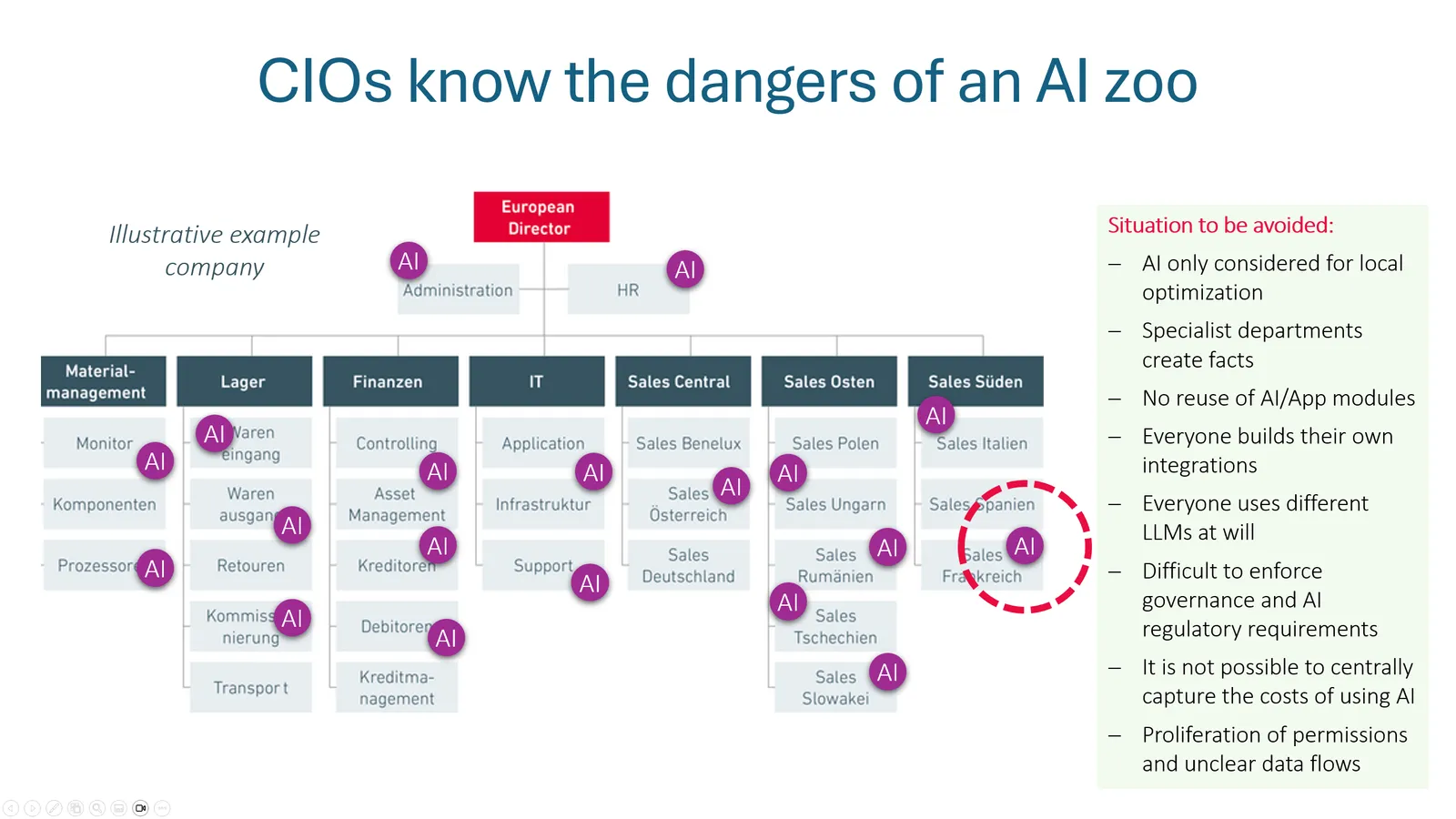
After an initial phase of experimentation, organizations are moving beyond simple pilots to integrate generative AI (GenAI) into their core production processes. The goal is clear: capitalize on the growth and profit benefits reported by early adopters and industry analysts.
For many leaders, this presents a unique opportunity to solve the persistent skills shortage. By leveraging AI, companies can scale their business output without exponentially increasing their workforce. However, the path is fraught with the risk of creating an unmanaged “AI zoo”—a collection of fragmented tools that lead to unmet expectations, security risks, and redundant investments.
A fundamental question remains: Is it wiser to wait for commercial AI products or develop custom AI tools in-house?
The Thesis for Custom AI Development
Historically, many organizations shied away from custom software due to high costs and a lack of specialized talent. However, the landscape for AI tool development has shifted. It is now often more advantageous to develop proprietary AI solutions—either internally or via strategic outsourcing—than to rely solely on off-the-shelf products.
This shift is driven by the need for bespoke process optimization, the falling barriers to AI creation, and the long-term economic advantages of owning the technology stack.
Strategic Advantages of Building Custom AI Tools
Tailoring Bespoke Processes Beyond Standard Solutions
Commercial AI products are designed for the “average” user to ensure broad market appeal. While they solve standard issues, they often fall short of optimizing the unique, end-to-end workflows that give a company its competitive edge.
- Fragmentation: Relying on separate AI assistants from Microsoft (Copilot), SAP (Joule), or Atlassian can lead to a siloed experience.
- Integration Limits: Adapting a provider’s AI to your specific environment often requires expensive licenses for every employee, even if they only need a fraction of the tool’s capabilities.
- Workflow Precision: Custom development allows you to build a tool that fits your specific data architecture and business logic perfectly.
The Declining Complexity of AI Implementation
While high-end applications like AI-driven telephony are complex, the majority of high-value corporate use cases are simpler than they appear. Many rely on Retrieval-Augmented Generation (RAG)—essentially a “chat with your documents” model.
Common, high-impact internal use cases include:
- Legal & Compliance: Analyzing contracts and policy documents.
- Knowledge Management: Querying intranet content or Confluence wikis.
- Technical Support: Interacting with source code and technical documentation.
Since roughly 80% of these solutions utilize standardized architectures, the “make” effort is primarily focused on the remaining 20%: the specific internal interfaces and unique system prompts.
Cost Efficiency and Scalability
The financial model for SaaS AI tools often scales poorly for large organizations. Most commercial providers charge per-user, per-month fees, which can become a massive recurring expense. In contrast, custom tools are often billed based on actual API usage or fixed infrastructure costs.
Consider a company with 1,000 employees:
- Buy (Commercial Licenses): 1,000 licenses at roughly €30/month leads to an annual cost of €360,000. Over five years, this exceeds €1.8 million in recurring costs.
- Make (Internal Development): An initial investment of €100,000 for development and €20,000 for annual maintenance totals only €180,000 over five years.
In this scenario, the “make” option can be nearly 90% cheaper while offering greater flexibility in how and where data is stored.
Ensuring Compliance and Future Innovation
Centralized Governance and Risk Management
Developing a centralized AI platform rather than purchasing scattered SaaS tools allows for superior oversight. A platform approach enables:
- Uniform Scaling: Reusing components across multiple departments reduces the cost of each new use case.
- Enhanced Security: Monitoring all AI requests in a single environment ensures that compliance rules are strictly followed.
- Feedback Loops: Centralized tracking of AI response quality allows for continuous model refinement.
Building Capabilities for New Business Models
Beyond immediate efficiency, developing internal AI provides a “digital laboratory” for future growth. As traditional businesses become increasingly software-driven, the ability to build and manage AI becomes a core competency. Companies that master AI integration today will be the ones creating the innovative, AI-driven products of tomorrow.
Conclusion: Making the Right Move
The decision to make or buy is rarely binary. However, the current trend suggests that “testing the waters” with custom development is a low-risk, high-reward strategy. By starting with a pilot project—perhaps focused on a specific internal knowledge base—your organization can gain the insights necessary to make informed long-term investments.
Whether you hire internal experts or partner with an experienced IT provider, the goal is to stop being a mere consumer of AI and start becoming a creator of value.