
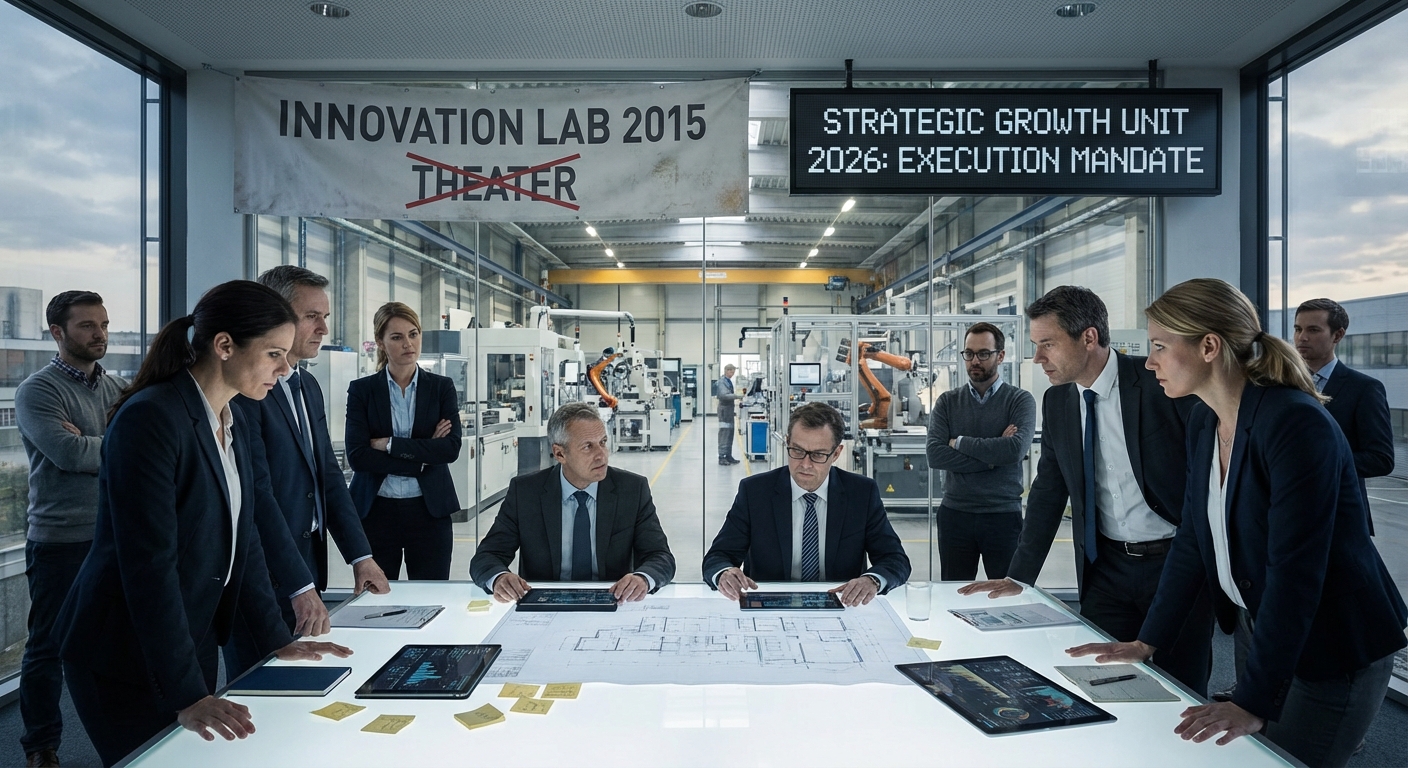
Anyone who followed the LinkedIn feed of an average innovation department between 2010 and 2020 knows the picture: hackathons with Post-its, stage-gate processes with a hundred columns, innovation labs with a barista corner. Lots of theater, few results. But in 2026, an uncomfortable question arises: Do we need exactly what failed back then — only this time with a mandate, capital, and the power to execute?
The Decade of Innovation Theater
Between 2010 and 2020, the German corporate world experienced a veritable wave of innovation — at least in its rhetoric. Idea workshops, hackathons, venture building, corporate startups: there was hardly a format that wasn’t tried. Anyone who observed this in the market at the time could recognize a recurring pattern: enormous effort, glossy keynotes, bold press releases — and in the end, few measurable results.
An important distinction needs to be made here: by “innovation theater,” I mean formats without a real mandate, without solid funding, and without integration into sales, product, and operations. And by innovation management, I don’t mean colorful workshops but a portfolio logic: capital allocation, clear decision rights, the building of new business units, and consistent execution all the way to market.
The problem wasn’t a lack of creativity or commitment. The problem was systemic. Radical innovation — not the incremental improvement of existing products, but genuinely new business models, new portfolio elements, SaaS instead of pure service business — requires a level of risk appetite, organizational change, and entrepreneurial perseverance that simply didn’t exist in German corporations. And, honestly: it wasn’t necessary either.
Why Innovation Wasn’t Necessary Back Then
You have to recall the economic conditions of 2018/2019. Germany was a humming export machine. Order books were full, the industrial base was strong, prosperity was secure. In such an environment, the rational path for most companies was: optimize costs, maintain the existing portfolio, maybe move a little toward the cloud — but please, not so far as to jeopardize their own business model.
Innovation in this phase was primarily a marketing instrument. A signal to employees, customers, and shareholders: Look, we’re future-proof. But the future didn’t need to be reinvented because the present was good enough. And so it remained innovation theater — at best a nice employer-branding measure, at worst an expensive exercise in self-deception.
The Wake-Up Call: Six Lost Years
And then reality hit. In 2025, Germany’s gross domestic product, adjusted for inflation, was only at the level of 2019 — six lost years. The ifo Institute recently warned of a 15-year stagnation phase and estimated the gap between expected and actual production potential at over five percent.
The upheaval is especially visible in the once-flagship automotive sector: in China, the combined market share of German brands shrank from 24 to around 15 percent. This is not a cyclical downturn that will correct itself with the next economic upswing. This is a structural shift — and a preview of what awaits other industries.
The Thesis: Innovation Management Wasn’t Wrong — It Was Too Early
Here’s the provocative twist. What if the innovation management of the 2010s didn’t fail because it was fundamentally wrong, but because it came at the wrong time?
It’s comparable to technologies that are ahead of their time: anyone who tried to build AI-driven editorial systems before GPT-3 failed due to technological immaturity — not the idea. Anyone who tried to establish innovation management in a corporation between 2010 and 2020 failed due to a lack of urgency, not a flawed concept.
Today, the urgency is here.
Why This Time Is Different
The situation has fundamentally changed. Three factors make the difference:
1. Efficiency gains are no longer enough. AI can automate processes and make teams more productive. But that won’t save a business model whose profit pools are eroding. Higher US tariffs, geopolitical uncertainty, and growing competition are weighing on the export economy — especially in automotive and mechanical engineering. The existing portfolio of Germany Inc. is under pressure, and that cannot be compensated by 10 percent more efficiency alone.
2. The old export formula no longer works. In the past, the German economy regularly pulled itself out of downturns through exports. That mechanism is broken. Competition is growing, and protectionist tendencies are reinforcing the trend. Those waiting for the next export boom may be waiting in vain.
3. The question is no longer whether, but where — and how focused. It’s no longer about whether companies should innovate. It’s about which bets they place: robotics? Drones? New service models? AI-native business models? Education and training as an exportable good? The bottleneck is less about “ideas” and more about direction, priority, and execution.
But Please, No Revival of the Old Play
If innovation management is making a comeback now, it must not be a rerun of 2015. The same hackathons, the same innovation labs in trendy Berlin factory halls, the same colorful slides in board presentations — that didn’t work then and won’t work now.
What needs to change are the framework conditions — on two levels.
What Companies Must Change
Risk appetite for capital. Radical innovation means that nine out of ten attempts fail. Anyone who doesn’t accept — and fund — this portfolio approach is still putting on theater. In Germany, capital is traditionally risk-averse, geared toward profitability and predictable returns. That was rational for a long time. It no longer is.
Organizational restructuring. Innovation isn’t just about having ideas. It requires new sales structures, new customer approaches, new capabilities. An organization that has been selling industrial services for 30 years cannot market SaaS products overnight. This transformation effort was massively underestimated during the innovation decade of the 2010s.
What Policymakers Must Deliver
Energy costs and infrastructure. Many of the most promising fields of innovation — AI, robotics, digital platforms — are energy-intensive. Without competitive energy prices, scaling in Germany remains utopian.
Labor market flexibility. Innovation requires experimentation, and experimentation requires the rapid buildup — and, if necessary, the rapid downsizing — of teams. German labor law makes exactly this extremely expensive and risky. Anyone who hires 30 people today to test a new business area and discovers there’s no market for it is left sitting on a financial sinkhole worth millions. That kills any appetite for experimentation.
The Strongest Counterargument — And Why It Falls Short
At this point, we must address the most obvious objection: “Germany doesn’t need new innovation management. It needs better framework conditions for existing business — less bureaucracy, lower energy costs, competitive taxes. The rest will follow on its own.”
This is the position of many SMEs and industry associations. And it’s not wrong — it just doesn’t go far enough. Yes, the framework conditions need to improve. But even under optimal conditions, the core problem doesn’t go away: if the markets where German companies were dominant are structurally shrinking, it helps little to run the existing business more cheaply. You’re then running a shrinking business more cheaply. Framework conditions are a necessary prerequisite — but not a sufficient one.
Companies must take innovation management seriously this time:
1. Multi-year budgets instead of quarterly logic. No “innovation pot” that gets cut in November, but a portfolio with clear expectations: some flops, a few breakthroughs.
2. A clear mandate — including cannibalization. If a new offering attacks the existing business, that must be allowed. Without this permission, every radical idea is politically dead on arrival.
3. Execution with P&L accountability. Less “lab,” more dedicated business unit or venture with clear targets: customers, revenue, margin, retention — and real resources from product, sales, and operations.
Five Theses for the Years Ahead
1. Innovation will shift from nice-to-have to a matter of survival. Companies that focus exclusively on efficiency gains and portfolio maintenance will be significantly worse off in five years.
2. The state will become an innovation driver — intentionally or not. Massive investments in infrastructure and defense will create demand. The question is whether genuine innovation ecosystems will emerge from this, or just a short-lived economic stimulus.
3. The services gap will become a major issue. In the US, the industrial economy managed the transition to a services and tech economy. Germany never fully made that shift. The coming years will reveal whether we can catch up on this transformation — or whether the industrial base continues to erode without an equivalent replacement emerging.
4. Innovation management will mature. If there is a comeback, it will be more sober than 2015. Fewer colorful Post-its, more hard metrics. Less “inspiration,” more “execution.” Fewer innovation labs, more dedicated business units with P&L accountability.
5. Germany needs a focused industrial policy strategy — and it’s missing. It’s not enough to bet on every card at once: AI, robotics, education, 3D printing, quantum computing. Whoever tries to do everything at once achieves none of it at critical mass. The directional decision is still pending — and it won’t be made in innovation departments, but in economic policy and in the boardrooms.
Conclusion
The innovation management of the 2010s was a phenomenon ahead of its time. Today, the urgency is real. If we fail to open up radically new business areas, we’ll have a problem that no efficiency program in the world can solve.
Whether the comeback succeeds depends on whether companies are willing to take real risks, and whether policymakers deliver the framework conditions that make scaling possible. Both remain open questions. But one thing has changed: the alternative to action is no longer the comfortable status quo. The alternative is decline.