
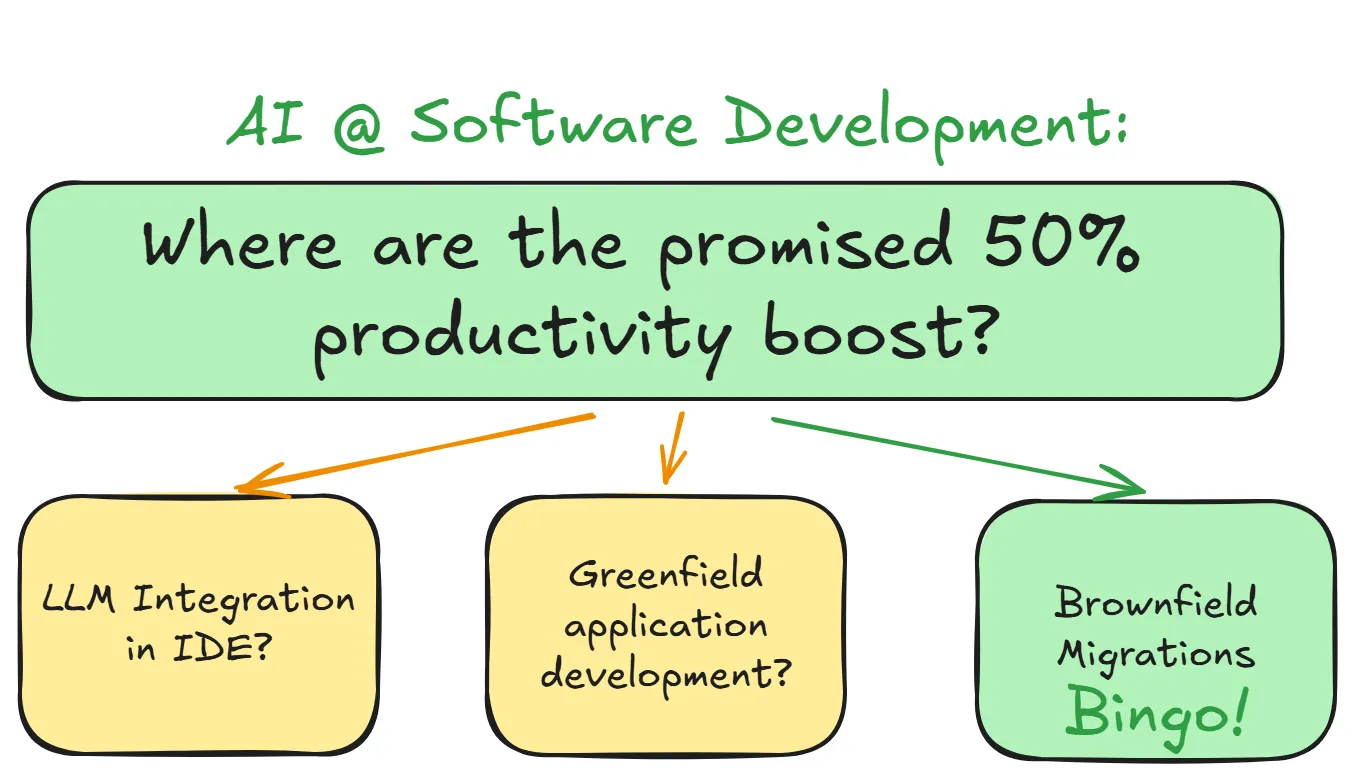
Assessing the impact of AI in software development depends heavily on the use case context.
AI in Software Development: Hype or Revolution? A Nuanced Perspective
AI in software development: hype or revolution? While some dream of quantum leaps in productivity and tech CEOs are already announcing layoffs, experienced developers remain skeptical. Will algorithms soon replace us all, or is AI just a glorified autocomplete?
This article dives into the debate, dissecting the various applications of AI in software development and highlighting where the technology truly shines – and where it (still) hits its limits. We’ll reveal why the key to success lies not in blind technological enthusiasm but in the strategic combination of AI with proven, deterministic development methods.
Discover how companies, particularly those with large, legacy codebases, can achieve not just incremental improvements but genuine, measurable productivity gains through the right application of AI – and why this principle is also transferable to smaller teams. But be aware: it’s not easy as just prompting for code.
Between Euphoria and Disillusionment: Two Perspectives on AI in Software Development
In the discourse surrounding AI in software engineering, two distinct camps emerge:
The AI Enthusiasts
- Productivity Metrics: Vendors tout productivity increases of up to 50% using tools like GitHub Copilot.
- Strategic Shifts: Tech leadership is already announcing hiring freezes or restructuring based on AI’s potential.
- Lowering Barriers: Coding novices are celebrating rapid success in implementing app ideas without extensive syntax knowledge, using AI to bridge the gap.
The AI Skeptics
- Complexity Bottlenecks: Experienced engineers report that AI can slow them down on creative problem-solving or architectural decisions.
- Context Window Limits: In medium-to-large repositories, Large Language Models (LLMs) often lose track of the “big picture,” making massive migrations difficult.
- Autocomplete Perception: Many senior users see AI as an enhanced autocomplete rather than a replacement for engineering logic.
Resolving the Apparent Contradiction: Context is Key
These differing experiences result from different application scenarios. The crucial factor is the context in which AI is used and the type of tasks it is meant to handle.
Three Use Cases: Where AI in Software Engineering Truly Shines
To understand these different perspectives, let’s examine three central use cases for generative AI in software development:
1. Greenfield Development with AI
Here, AI generates code based on user requirements from scratch. As long as the complexity remains within the LLM’s context window, the results are highly usable. Errors are fixed iteratively through the standard interfaces of ChatGPT, Claude, or Gemini.
- For Pros: AI generates boilerplate code instantly, saving hours of manual setup.
- For Beginners: It provides a low-barrier entry point to achieve functional results quickly.
2. AI as a Tool in Existing Projects
Integration into the IDE allows AI to assist with daily maintenance. Concrete benefits include:
- Intelligent Autocomplete: Accelerating the writing of repetitive logic.
- Q&A and Debugging: Asking questions about specific functions to receive instant explanations.
- Code Review Fixes: Suggesting patches for errors identified during peer reviews.
- Readability Improvements: Refactoring code for better maintainability and documentation.
In this scenario, AI serves as a “force multiplier” for the individual. However, the often-cited 50% productivity increase is hard to prove here because individual developer output is notoriously difficult to quantify.
3. AI-Driven Process Optimization in Large Projects
This is where AI transitions from a “helper” to a “revolutionary.” This scenario involves clearly defined work packages—like code migrations and refactoring—to reduce technical debt.
In massive organizations, maintenance consumes more resources than feature development. Migrating outdated libraries (e.g., JUnit3 to JUnit4) might require 300 person-days. Because these tasks are repetitive and follow defined patterns, they are ripe for AI-driven industrialization.
Google Shows How It’s Done: A Real-World Example
Google recently published findings on code migrations that achieved a 50% reduction in end-to-end processing time. Their success relied on a three-stage hybrid approach:
- Deterministic Code Analysis: Using tools like Kythe and Code Search to identify relevant code sections with 100% precision.
- Fine-Tuned LLMs: Applying a Gemini model trained on Google’s internal codebase to perform the actual transformations.
- Human Review: Expert engineers checking the final output to ensure architectural integrity.
Case Study: Google’s Int32 to Int64 ID Migration
Google faced a massive task: migrating its ID management system from 32-bit to 64-bit to prevent system overflows.
- The Challenge: The IDs were deeply embedded across tens of thousands of locations. A manual migration would have cost hundreds of developer-years.
- The AI Solution: By combining automated identification with AI-driven implementation and human oversight, Google automated 80% of the final code changes.
- The Result: A 50% time saving and millions of dollars in preserved resources.
50% Productivity Increase: The Strategically Planned Conditions
The Google case study proves that while AI isn’t a silver bullet, it is a powerhouse under specific conditions:
- Focus on Migrations: Large, well-defined projects offer the highest leverage for AI automation.
- The Hybrid Approach: You must combine the flexibility of LLMs with the “truth” of deterministic code analysis (AST-based methods).
- Strategic Investment: Building the infrastructure to support AI migrations requires upfront effort but pays off in long-term technical debt reduction.
- Scalability: These principles aren’t just for tech giants; they apply to any company in finance, insurance, or automotive sectors with significant legacy systems.
Conclusion
AI in software development is currently in an “early-adoption” evolution. The reality is multifaceted: while generic prompting offers incremental gains, the true revolution lies in integrated, hybrid processes for large-scale engineering.
The key to success is not choosing between human intuition and AI speed, but rather blending AI technologies with proven software development methods. Companies that start identifying these high-leverage use cases today will be the ones to unlock the full potential of this technology.