
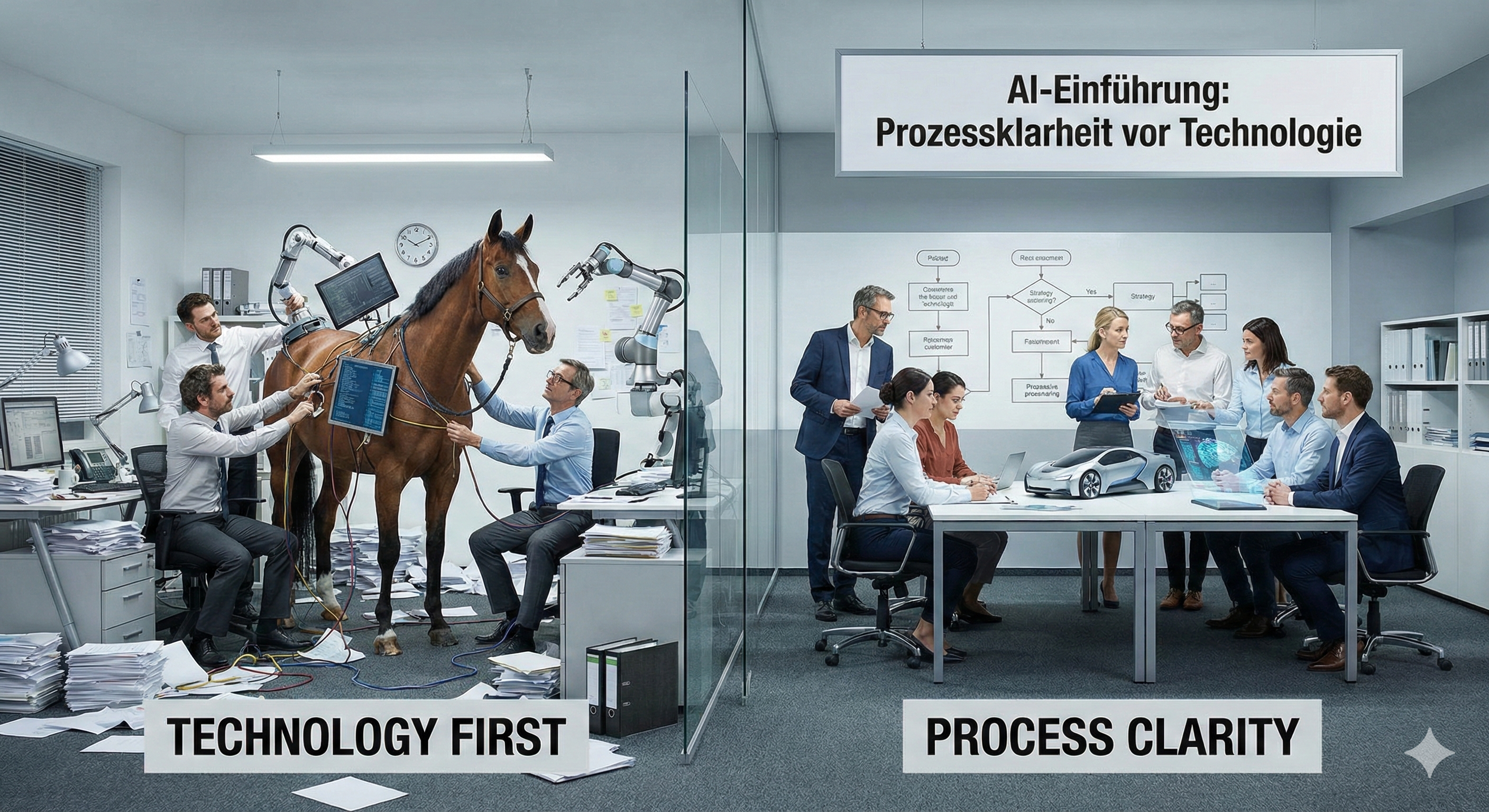
Process Clarity Before Technology
In many corporations, a pattern keeps repeating itself: business units know they need to use AI. They understand the strategic necessity. They nod in meetings. And then they wait. They wait for someone to come and show them how to do it.
The problem: This someone doesn’t exist in sufficient numbers. A mid-sized corporation has hundreds of departments. There simply aren’t enough consultants who could spoon-feed each individual business unit their AI strategy. The uncomfortable truth is: business units must take action themselves. And the first step isn’t talking about AI.
The Status Quo: Early Adopters and the Waiting Majority
Every business unit has them: the early adopters. They use ChatGPT for their daily tasks, experiment with Copilot, or have even set up their own agent systems. These colleagues already work significantly more efficiently than they did two years ago.
But they’re the exception. The vast majority behaves passively. People wait for training sessions, for use-case catalogs, for ready-made solutions. When asked for concrete ideas, suggestions follow a familiar pattern: slapping AI as a band-aid over annoying tasks. Automating a tedious Excel evaluation here, a recurring email template there. Point improvements, not well-thought-out end-to-end solutions.
The Real Hurdle: Lack of Process Clarity
When you dig deeper and ask which processes should actually be automated, the real problem reveals itself. The answers remain vague. Documentation doesn’t exist or is outdated. Often it turns out: there isn’t even a uniform process. Everyone does it differently.
How is AI supposed to optimize a process that nobody can describe?
This is the core of the challenge. Before discussing AI tools, use cases, and implementation, a fundamental question must be answered: What actually are the recurring workflows in this department? What do they look like? How varied are they? And how should they ideally look?
Rethinking Processes Instead of Automating Old Workflows
A frequently cited image puts it succinctly: With AI, we don’t want to automate the horse, but invent the automobile. This means: it’s not about rebuilding existing processes one-to-one with AI support. It’s about rethinking processes from the ground up.
An example from controlling: A controller might traditionally be able to intensively monitor 40 cost centers. With AI support, they could monitor all cost centers, with anomaly detection, automatic alerts, and predictive analytics. This changes not just the process, but the entire role.
That’s precisely why it’s so important to already consider new possibilities during process analysis. Don’t ask: How can we speed up the current workflow? Instead ask: How would we design this workflow today if we were starting from scratch?
Why Business Units Can’t Wait for Consultants
In strategically central areas, corporations will naturally set up task forces. When an insurer transforms its claims management, that’s not a project for the business unit to tackle alone. This requires dedicated resources, external expertise, and intensive support.
But most departments don’t fall into this category. The controlling department of a mid-sized company, internal communications, facility management; these areas won’t be at the center of an AI strategy. Here, leaders must take action themselves.
The good news: the hurdle is lower than expected. Because the first step has nothing to do with AI.
A Pragmatic Approach for Business Units
Step 1: Make workflows visible. Before talking about AI, every business unit should document its recurring processes. Not in perfect flowcharts, but in understandable form: what happens when, who’s involved, which systems are used, where are the pain points?
Step 2: Recognize and standardize variants. In many teams, chaos has developed over the years. Everyone works slightly differently. Before introducing AI, it’s worth asking: is there a good reason for these differences? Or would a uniform process make more sense?
Step 3: Think radically new. With the process overview in hand, the question can now be asked: what would this workflow look like if we redesigned it today with all available possibilities? This is where AI potentials come into play, but also other improvements like system integration or task redistribution.
Step 4: Seek inspiration. Use cases from other companies help expand the realm of possibilities. This doesn’t have to go through corporate departments. Newsletters, industry publications, and simple Google searches continuously deliver new ideas directly to your inbox.
Step 5: Start small. Don’t develop the perfect master plan, but select one concrete process and start there. Gather experience, learn, iterate.
The Responsibility Lies with the Business Unit
The introduction of AI in business units rarely fails because of technology. It fails due to lack of clarity about one’s own processes and the expectation that someone else will do the work.
Corporations can create framework conditions, provide tools, and drive strategically important transformations centrally. But for the majority of departments, this applies: whoever waits, loses time. The first step isn’t an AI workshop, but an honest look at your own workflows. Only when these are understood and described can the actual transformation begin.